
AI Agent Development: Costs, Tiers, and When You Actually Need It
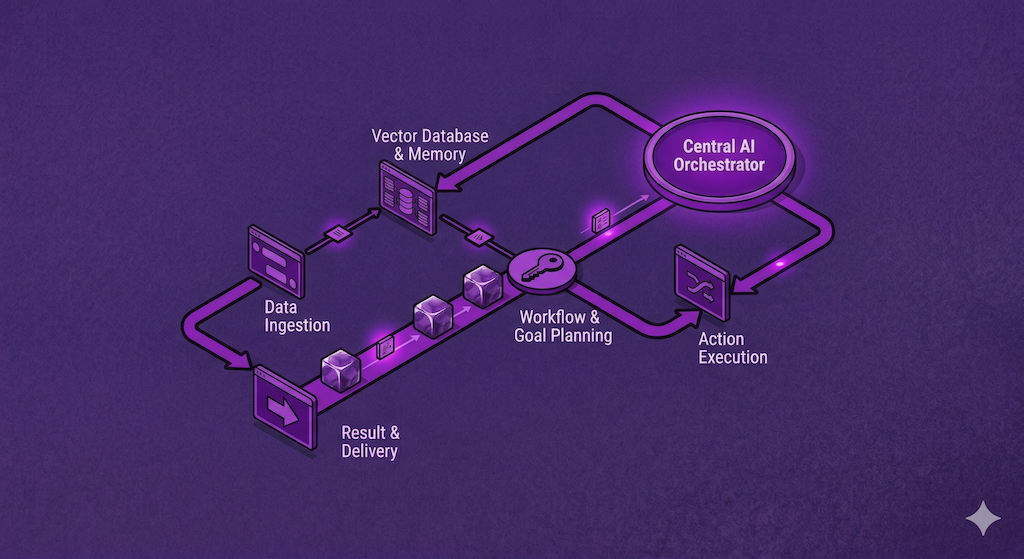
- Why a demo agent with 90% reliability fails at production scale — and what production hardening actually adds to the build cost
- The specific story-point ranges and dollar figures that separate a $3,000 single-tool agent from a $45,000 multi-agent system
- Exactly when buying off-the-shelf beats custom development — and the mistake operators make by skipping this question
- Five line items that silently push an AI agent quote from $9,000 to $22,000 or higher
- The six questions every scoping brief must answer before you approach a vendor
Everyone wants an AI agent. Few people can describe what that means — and even fewer can describe what one should cost. That gap is where vendors thrive and buyers lose money.
What is an AI agent, and how is it different from a chatbot?
A chatbot responds to input. An agent pursues a goal.
That’s the simplest useful distinction. A chatbot takes a message and returns a message. An AI agent takes a goal, decides what actions to take to achieve it, executes those actions using tools, and adjusts based on the results. It can call APIs, read and write files, search the web, send emails, query databases, or trigger other software systems.
AI agent: a software system that uses a large language model as its reasoning engine, combines it with tool access — APIs, databases, file systems, external services — and runs in a goal-directed loop: perceive, reason, act, observe, and repeat. Unlike a chatbot, which handles single-turn inputs, an agent pursues multi-step goals autonomously without requiring human intervention at each step.
The agent uses a large language model (LLM) as its reasoning engine, but the LLM is not the product. The product is the loop: perceive, reason, act, observe, repeat. IBM’s technical documentation describes this cycle well: an agentic system collects data from its environment, reasons over it, sets objectives, selects an action, executes it, and then evaluates the outcome to improve future decisions. That loop is what separates an agent from a model.
What makes an agent an agent is goal-directed behavior plus tool use. Remove either one, and you have something simpler. The term “agentic” refers directly to this capacity to act independently and purposefully — not just to respond.
“Agentic AI” became the phrase vendors attach to almost anything, from a chatbot with a slightly better prompt to a genuinely autonomous system executing multi-step workflows. Gartner projects that 40% of enterprise applications will include task-specific AI agents by the end of 2026, up from less than 5% in 2025. The demand is real. But for a non-technical operator trying to evaluate whether your business needs custom AI agent development — and what it should cost — the current landscape is nearly impossible to read.
What are the three tiers of AI agents and what does each cost to build?
Not all agents are the same in complexity, risk, or cost. Most conversations about custom AI agent development collapse because buyer and vendor are picturing different tiers. Here is a working taxonomy.
| Tier | What it does | Story points | Cost range | Timeline |
|---|---|---|---|---|
| Tier 1: Single-Tool Agent | One task, one tool, one loop | 20–40 | $3,000–$6,000 | 2–4 weeks |
| Tier 2: Orchestrated Agent | Multi-step sequence, state management across steps | 60–120 | $9,000–$18,000 | 4–8 weeks |
| Tier 3: Multi-Agent System | Multiple specialized agents coordinating in parallel | 150–300+ | $22,000–$45,000+ | 8–16 weeks |
Tier 1: Single-Tool Agent (Simple)
What it is. An agent with one tool, one task, one loop. It takes input, calls a tool, returns output. “Summarize this document and extract the action items.” “Classify this customer support ticket and route it.”
Build stack. LLM selection (OpenAI, Anthropic, Gemini, or open-source depending on latency and cost needs). One tool integration (file reader, API call, database query). A prompt chain with basic input/output schema. Minimal state, no memory across sessions. Guardrails: output validation, error handling, rate limiting.
What’s harder than it looks. Output reliability at scale. A single-tool agent that works 90% of the time in demos fails operationally when it’s processing 500 documents a day. Production hardening often takes more engineering time than the initial build. This is consistent with what Gartner flagged when it predicted at least 30% of generative AI projects would be abandoned after proof of concept by end of 2025, citing poor data quality, escalating costs, and unclear business value.
This tier is right for well-scoped internal automation: a document classifier, a data extractor, a simple intake router. For teams looking to boost human productivity with AI, a Tier 1 agent targeted at one specific workflow is often the highest-ROI starting point.
Tier 2: Orchestrated Agent (Multi-Step)
What it is. An agent that executes a sequence of steps to complete a more complex goal. “Research this company, summarize the findings, draft an outreach email, and flag it for human review before sending.” Each step depends on the previous. The agent manages state across the sequence.
Build stack. LLM (usually higher capability than Tier 1, because multi-step reasoning increases error compounding risk). Multiple tool integrations (web search, CRM API, email, document store). State management across steps. A planning layer: either a simple chain-of-thought loop or a structured planner (ReAct, LangGraph, or similar). Human-in-the-loop checkpoints for compliance-sensitive environments. Eval framework to measure whether the agent’s output is correct.
What’s harder than it looks. Error recovery and branching. When step 3 fails because the CRM API returned unexpected data, what does the agent do? Writing robust failure logic for every fork is the part that takes real engineering time and is almost always underestimated in early quotes.
This tier is appropriate for knowledge work automation where sequence matters: research workflows, proposal generation, client intake, compliance documentation.
Not sure which tier your project needs?
Get a structured cost estimate with story-point ranges by component — agent architecture, tool integrations, eval infrastructure, and deployment. Free and instant.
Scope Your Project for FreeNo call required. Takes a few minutes.
Tier 3: Multi-Agent System (Production)
What it is. Multiple specialized agents working in coordination. A planning agent breaks a goal into subtasks. Specialist agents execute each subtask. A review agent checks outputs before they exit the system. The whole thing runs in parallel where possible.
This is what IBM describes as an agentic architecture with a “conductor” model overseeing tasks and decisions while supervising simpler, specialized agents. The orchestration can be vertical (hierarchical, with one agent directing others) or more horizontal, with agents collaborating as equals. Each model has tradeoffs: hierarchical systems are faster but prone to bottlenecks. Decentralized systems are more resilient but harder to debug.
Build stack. Agent orchestration layer (LangGraph, AutoGen, custom orchestrator). Separate agents for separate domains, each with their own tools, prompts, and state. Message passing and coordination logic between agents. Persistent memory and session management. Evaluation at both the agent level and the system level. Security controls: agent permissions, rate limiting, audit logging. Deployment infrastructure: this is not running on a laptop.
What’s harder than it looks. Emergent failures. When four agents are coordinating on a workflow, bugs become non-linear. Testing a single agent is manageable. Testing interaction effects across a multi-agent system requires a different approach entirely. This is where underfunded builds fail silently.
This tier is for complex, high-volume operational workflows: insurance underwriting pipelines, multi-source research platforms, autonomous operations monitoring. Teams working toward this scale should consider scaling production-grade AI with fractional LLM and RAG engineers rather than building a full-time AI team before the system architecture is proven.
Should you build a custom AI agent or buy an off-the-shelf solution?
Before you spec a custom agent, answer this question honestly: does an off-the-shelf platform already do what you need?
Platforms like Zapier, Make, n8n, and Notion AI have added agentic features. Microsoft Copilot, Salesforce Einstein, and HubSpot AI are building deeply into their existing toolchains. If your use case lives inside one of those ecosystems, custom development may not be the right answer. Not yet.
Build custom when: your data or workflow doesn’t fit a standard platform’s model; you need the agent embedded in a proprietary system (your app, your portal, your API); compliance or data residency requirements rule out third-party platforms; the workflow is complex enough that no-code tools break down at the edges; you need the agent’s behavior to be configurable, not just its inputs.
Buy or configure when: the use case is generic — document summarization, basic routing, simple Q&A; speed to deployment matters more than customization; you’re testing whether the use case creates measurable value before committing to a build.
The mistake operators make is building Tier 3 when Tier 1 would prove the concept. And the mistake vendors make is quoting Tier 3 when the buyer asked for something much simpler.
What drives AI agent development costs higher than the initial estimate?
These are the line items that turn a $9,000 orchestrated agent into a $22,000 one:
LLM API costs at scale. The agent itself may cost $12,000 to build. But if it processes 50,000 requests a month using GPT-4o, the monthly API bill is real and ongoing. Get a usage estimate before you commit.
Evaluation infrastructure. You cannot ship a production agent without a way to measure whether it’s working correctly. Eval frameworks, golden datasets, and regression testing add scope that most first-time buyers don’t include in their initial brief.
Human-in-the-loop workflows. If your use case requires human review before the agent acts — common in healthcare, legal, and financial services — you’re building an approval interface, a notification layer, and a correction mechanism. Each adds story points.
Integration complexity. Calling a clean REST API is simple. Integrating with a legacy CRM that has inconsistent data models is not. The more systems the agent touches, the higher the variance in the estimate.
Compliance and audit requirements. If every agent action needs to be logged, explainable, and auditable, that adds infrastructure. It’s not optional in regulated industries.
What does ongoing AI agent maintenance actually cost?
An AI agent is not a static piece of software. LLM providers update models. APIs change. Prompts that work today drift as the underlying model is fine-tuned. Output formats change. Tool schemas change.
For a production agent, budget roughly 10 to 20 percent of initial build cost per year for maintenance, monitoring, and prompt tuning. A $15,000 orchestrated agent might cost $1,500 to $3,000 per year to keep reliable.
Buyers who skip this budget tend to find out about it six months after launch when the agent starts returning degraded output and no one knows why. This is one of the reasons RAND’s research on AI project failures emphasizes that organizations need to invest in infrastructure for model deployment and ongoing governance — not just the initial build.
For teams with a problem-first mindset, taking a problem-first approach to building agentic AI makes the ongoing maintenance budget easier to justify, because success criteria are defined upfront rather than retrofitted after launch.
What are the real risks when an AI agent fails?
This is the part most vendor conversations skip.
Agentic systems are powerful precisely because they act autonomously across multiple steps. That autonomy is also where risk concentrates. If the goal is poorly defined, or the reward signal is misaligned, the agent will optimize for something you didn’t intend.
IBM’s technical overview flags several realistic failure modes: an agent optimizing for engagement that surfaces misleading content, a trading agent that takes on excessive risk in pursuit of returns, a content moderation agent that over-censors legitimate discussion. None of these are hypothetical. They’re the predictable result of deploying autonomous systems without clearly defined success criteria and feedback loops.
For operators building agents in regulated industries, the implication is direct: guardrails are not optional. They are part of the build. Budget them accordingly.
What should a good AI agent scoping brief include?
The single biggest driver of estimate variance is a vague brief. “We want an AI agent to help our sales team” produces a range so wide it’s useless.
A scopeable brief answers six questions:
- What specific goal does the agent pursue?
- What systems or data sources does it need to access?
- What does “done” look like for a single successful run?
- Who reviews the agent’s output before it acts, and in what scenarios?
- What happens when the agent fails or produces wrong output?
- How many requests per day, and what is the latency requirement?
These are not technical questions. They’re operational ones. Answering them before you approach a vendor changes the conversation entirely — and prevents the common pattern of scope expanding quietly after kick-off while change orders follow.
Fraction builds AI agents across all three tiers. Before a single line of code is written, we scope the build, define the assumptions, and produce a structured cost estimate with story-point ranges by component: agent architecture, tool integrations, eval infrastructure, human-in-the-loop flows, deployment. If you’ve been quoted a number for an AI agent with no breakdown of what drives it, the Fraction Instant Project Estimator gives you an independent reference point before you sign anything.
AI agents in 2026 are genuinely capable of things that weren’t possible two years ago. But the gap between a demo and a production system is still significant, and the gap between a vendor’s description and what they actually deliver is still wider than it should be. The fix is not more AI literacy. It’s better procurement — knowing which tier you need, what drives cost in that tier, and what a reasonable range looks like before you sign anything.
Frequently asked questions
What is the difference between an AI agent and a chatbot?
A chatbot responds to a single input and returns a single output. An AI agent takes a goal, decides what steps to take to reach it, uses tools to execute those steps, and adjusts based on the results. The key distinction is goal-directed behavior combined with tool use — an agent perceives its environment, reasons, acts, and evaluates the outcome in a loop, without requiring human intervention at each step.
How much does it cost to build a custom AI agent?
It depends on which tier you need. A Tier 1 single-tool agent typically costs $3,000–$6,000 and takes 2–4 weeks. A Tier 2 orchestrated multi-step agent runs $9,000–$18,000 over 4–8 weeks. A Tier 3 multi-agent production system costs $22,000–$45,000 or more and takes 8–16 weeks. The biggest driver of cost variance is scope clarity — a vague brief produces estimates so wide they are useless.
When should you build a custom AI agent instead of using an off-the-shelf tool?
Build custom when your data or workflow does not fit a standard platform, when you need the agent embedded in a proprietary system, when compliance or data residency rules out third-party tools, or when no-code solutions break down at the edges of your use case. Buy or configure when the use case is generic, when speed to deployment matters more than customization, or when you are still testing whether the use case creates measurable value before committing to a build.
Why do so many AI agent projects fail after the proof of concept stage?
The most common failure mode is a scoping problem, not a technology problem. Gartner predicted that at least 30% of generative AI projects would be abandoned after proof of concept by end of 2025, citing poor data quality, escalating costs, and unclear business value. Agents that work 90% of the time in demos fail operationally at scale. Production hardening — output validation, error recovery, eval frameworks, and human-in-the-loop workflows — adds scope that most first-time buyers do not include in their initial brief.
How do you scope an AI agent project to avoid unexpected cost overruns?
A good scoping brief answers six questions before you approach any vendor: What specific goal does the agent pursue? What systems or data sources does it need to access? What does a single successful run look like? Who reviews the agent’s output before it acts? What happens when the agent fails or returns wrong output? How many requests per day, and what is the latency requirement? Answering these upfront prevents the common pattern of scope expanding quietly after kick-off.
- IBM. “What is Agentic AI?” IBM Think. https://www.ibm.com/think/topics/agentic-ai
- Gartner. (2025). “Gartner Predicts 40% of Enterprise Apps Will Feature Task-Specific AI Agents by 2026.” August 26, 2025. gartner.com/en/newsroom/…
- Gartner. (2024). “Gartner Predicts 30% of Generative AI Projects Will Be Abandoned After Proof of Concept by End of 2025.” July 29, 2024. gartner.com/en/newsroom/…
- RAND Corporation. (2024). The Root Causes of Failure for Artificial Intelligence Projects and How They Can Succeed. https://www.rand.org/pubs/research_reports/RRA2680-1.html