
AI Is Killing SaaS Margins. Outcome-Based Pricing Is How You Get Them Back.
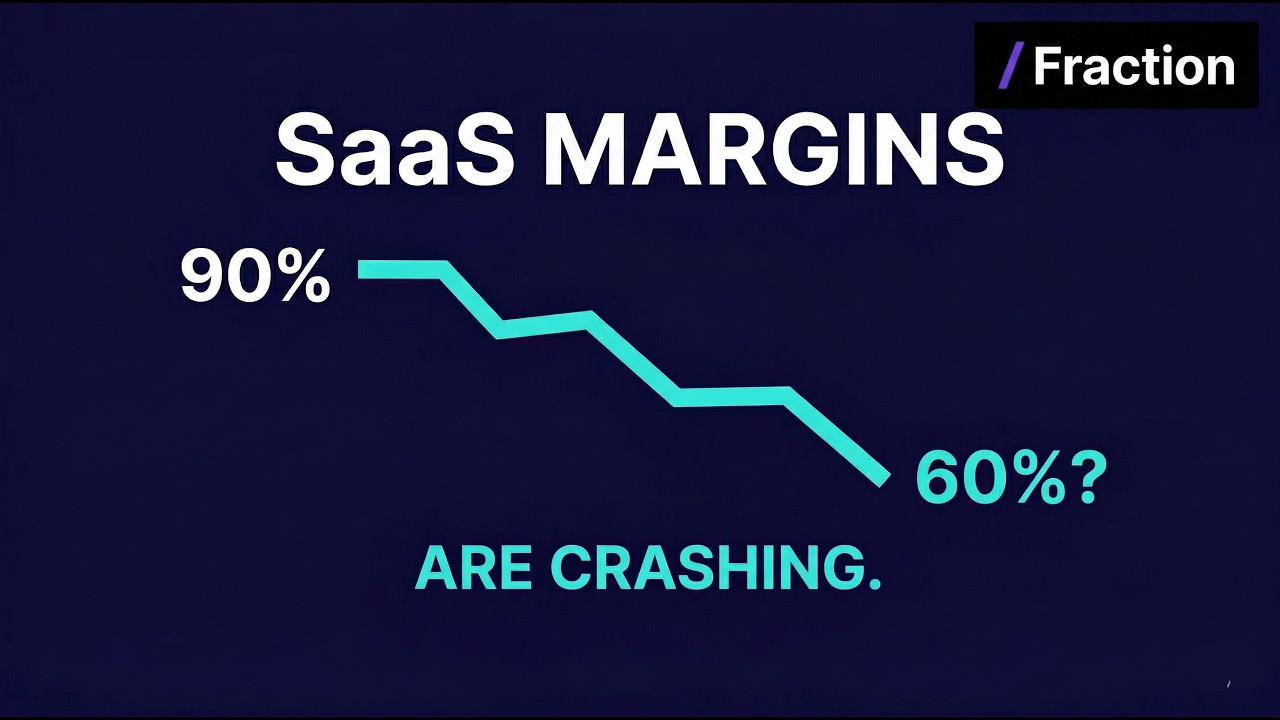
- Why AI token and inference costs are cutting SaaS gross margins by 20–30 percentage points compared to pre-AI products
- How cloud credit arbitrage (AWS → GCP → Azure) masks the true margin problem — and what the reckoning looks like when credits run out
- The specific ROI math that justifies charging $5,000 for a job that replaced a $40,000-per-year employee
- Why 92% of AI software companies now use hybrid pricing models instead of pure flat-rate subscriptions
- How Gartner projects the pricing shift — and which enterprise software leaders (Zendesk, Intercom, Salesforce) have already made the move
AI changed the unit economics of software overnight — and most SaaS companies are still pricing like it didn’t.
Why are AI features compressing SaaS gross margins?
For most of the SaaS era, the gross margin story was simple: build the software once, sell it forever, keep 80 to 90 cents of every dollar. The marginal cost of serving another customer was nearly zero. Infrastructure scaled cheaply. Gross margin was a feature of the business model itself.
AI broke that. Every time a user interacts with an AI feature — every query, every inference, every agent action — real compute gets consumed. Token costs, GPU time, and third-party API fees stack up with every user interaction. The software is no longer free to operate at scale; it has a cost that grows with usage.
The result: companies that were accustomed to 80 to 90% gross margins are now seeing 50 to 60%, or worse. That is not a rounding error. That is 20 to 30 margin points evaporating because of a single product decision — to add AI. And the pressure compounds as AI features become table stakes rather than differentiators. You cannot take them out. You cannot price them away. You have to absorb the cost or find a smarter way to price.
The smarter way exists. But to understand it, you first need to understand why so many companies are successfully hiding the problem — and what happens when the hiding stops.
How does cloud credit arbitrage mask the AI margin problem?
A significant portion of early-stage AI companies are not running on real economics. They are running on cloud credits — promotional compute budgets offered by AWS, Google Cloud, and Azure to attract promising startups into their ecosystems. A company can spend six to twelve months burning through $500,000 in Azure credits, then move to GCP for another round, then shift to AWS. During that time, their infrastructure looks essentially free.
This is not a hypothetical. It is a well-documented pattern in the startup ecosystem. The problem is that it creates two entirely separate economic realities: the one the company appears to operate in, and the one it will actually face once the credits run out.
The reckoning, when it arrives, is severe. Replit, one of the most high-profile AI coding platforms, disclosed that it was operating at negative gross margins — meaning it was losing money on every user it served, not just on overhead. GitHub Copilot reportedly lost approximately $80 per user per month in its early days, with heavy users consuming far more compute than the subscription price covered. These are not obscure companies. They are well-funded, well-known products with serious engineering teams. The economics still broke.
The credit arbitrage game ends. Companies that have been winning on subsidized compute eventually have to confront actual infrastructure costs. The ones that have not built pricing that reflects real unit economics arrive at that moment with no good options: raise prices dramatically, cut features, or accept permanently compressed margins. None of those are attractive. The companies that built pricing strategy into their AI roadmap from the beginning are in a fundamentally different position. As detailed in our analysis of how AI changes the SaaS margin equation, the math that worked before 2023 simply does not apply to AI-augmented products.
How does usage-based pricing protect AI product margins?
Usage-based pricing is the first meaningful structural response to the AI cost problem. Instead of a flat per-seat fee that does not move regardless of how much AI compute a customer consumes, usage-based pricing ties revenue directly to consumption. If a customer generates more AI interactions, they pay more. The cost and the revenue scale together.
The risk-transfer logic is direct: under flat-rate pricing, the vendor absorbs the full cost of a heavy user. Under usage-based pricing, the heavy user pays for their own consumption. Tail risk — the user who hammers your AI 10,000 times a month while paying the same as the user who uses it twice — largely disappears.
The adoption numbers reflect this. According to research from Bessemer Venture Partners, approximately 92% of AI software companies now use some form of mixed pricing that includes a usage-based component. That is not a trend; it is a near-universal response to the same structural problem. Flat-rate subscriptions work when marginal cost is near zero. They break when every interaction has a cost.
| Model | Risk to vendor | Revenue ceiling | When to use |
|---|---|---|---|
| Fixed Subscription | High — absorbs all heavy-user compute costs | Low | Near-zero marginal cost products; pre-AI SaaS |
| Usage-Based | Medium — cost and revenue scale together | Medium | AI products with variable consumption patterns |
| Outcome-Based | Low — only paid when AI delivers value | High | AI that completes discrete, verifiable tasks end-to-end |
Usage-based pricing is a defensive move. It protects margins by ensuring the vendor is not silently subsidizing consumption. But it does not unlock new revenue. It moves the pricing model from “charge for access” to “charge for consumption” — a meaningful improvement, but not the full opportunity available to AI companies. For a deeper look at how the entire SaaS pricing stack is being restructured, see our companion piece on how AI is forcing a rethink of software pricing.
Why is outcome-based pricing the real revenue opportunity for AI companies?
Usage-based pricing asks: how much did you use? Outcome-based pricing asks a different question: did the AI actually do the job? That distinction, small on the surface, is enormous in practice.
Outcome-based pricing is a model in which a software vendor charges based on the completion of a specific, measurable result — rather than for access to a tool or for the volume of usage. The customer pays when the AI delivers a verifiable outcome: a support ticket resolved without human intervention, an appointment booked, a legal brief evaluated, a lead qualified. If the outcome is not achieved, no charge is incurred.
The model has real-world proof. ZyraTalk, an AI agent platform for home services businesses, built its entire pricing around completed bookings and booked appointments — jobs the AI finished on behalf of businesses without human involvement. The company was acquired by EverCommerce, a signal that outcome-based AI products command meaningful exit multiples even in a compressed funding environment.
The pattern appears across verticals. Legal tech platforms are charging per contract reviewed and per clause flagged. Travel AI is charging per itinerary built. Project management AI is charging per task completed autonomously. The common thread: the AI takes something from start to finish, and the vendor is paid for completion, not for the attempt.
The revenue math is qualitatively different from SaaS. A software tool that saves a paralegal four hours per week might justify $200 per month. An AI that does the work of a paralegal — producing deliverables end-to-end — can justify pricing against the cost of the employee it replaced. A $40,000-per-year paralegal costs roughly $3,300 per month. An AI delivering equivalent output can credibly charge $5,000 per month and still look like a bargain. The ceiling for outcome-based pricing is not “what is the software worth?” It is “what is the work worth?” — and that is almost always a larger number.
Repricing your AI product for outcomes?
Fraction helps SaaS companies design and implement pricing transitions — from flat-rate to usage-based to outcome-aligned models. Talk to us about your roadmap.
Talk to FractionNo commitment. 30-minute strategy call.
What is the catch with outcome-based pricing?
Outcome-based pricing sounds ideal. In practice, two structural challenges slow its adoption.
The first is completion rate. AI agents do not complete every task successfully. Across a range of AI assistant and agent products, typical completion rates sit somewhere between 50 and 60 percent for complex tasks. That means 40 to 50 percent of interactions — interactions that consumed real compute — do not generate revenue under a pure outcome-based model. If you price only on completed outcomes, you are implicitly subsidizing the failures. Depending on your cost structure, that can be unsustainable.
The second challenge is attribution. In many workflows, AI is one part of a larger system involving human judgment, integrations, and external systems. Who gets credit when the outcome is achieved? If a sales AI identifies a lead but a human rep closes the deal, is the outcome the lead or the closed contract? If an AI drafts a legal brief but a lawyer reviews and edits it, what exactly did the AI deliver? The more complex the workflow, the harder it becomes to draw clean attribution lines — and clean attribution is a prerequisite for clean pricing.
These challenges explain why Bessemer Venture Partners, in their AI pricing and monetization playbook, recommends hybrid models as the practical middle ground. A hybrid structure pairs a base subscription — which covers fixed costs, provides revenue floor predictability, and accounts for the cost of incomplete tasks — with an outcome-based component that charges for measurable results above that baseline. The vendor is not fully exposed to the risk of AI failures. The customer is not paying full freight when the AI does not perform. Both sides get aligned incentives without the structural risks of a pure outcome-only model.
What does the AI pricing shift mean for software buyers and builders?
The pricing spectrum running from fixed subscription to usage-based to outcome-based is not just a vendor strategy question. It has direct implications for every company buying or building software in an AI-augmented world.
For software buyers: the deal you sign today is almost certainly not the deal you will renew in two years. Vendors who are currently bundling AI into flat-rate subscriptions are quietly absorbing costs they will eventually have to surface. Budget conversations that assume flat pricing for AI-powered tools need to be revisited. The smarter move is to negotiate for usage-based or outcome-based pricing now — particularly for tools where the AI delivers discrete, measurable results. You get the benefit of vendor alignment, and you avoid the sticker shock of a re-pricing event you did not see coming.
For software builders: the companies moving fastest are not treating pricing as an afterthought. They are designing pricing into the product architecture from the start — building the instrumentation to track outcomes, the dashboards to surface them for customers, and the contract structures to monetize them. Gartner projects that by 2030, at least 40% of enterprise SaaS spend will shift toward usage-, agent-, or outcome-based pricing. The category leaders — Zendesk at $1.50 to $2.00 per resolved support ticket, Intercom at $0.99 per AI-resolved conversation, Salesforce pricing Agentforce on completed actions — have already made the structural commitment. They are not waiting to see how the market evolves.
The practical starting point is the spectrum itself. Almost no company should jump directly from flat-rate subscription to pure outcome-based pricing. The intermediate steps matter. Start with usage instrumentation: know what your AI is actually doing and what it costs. Move to a usage-based component that recovers infrastructure costs. Build dashboards that track and surface outcomes to customers. Then begin introducing outcome-based pricing in new contracts, in new segments, or for new product lines where the outcomes are clean and verifiable. The goal is not to renegotiate every contract overnight; it is to ensure that the next wave of contracts reflects the economics of what you are actually selling. For companies struggling with the revenue pressure side of this equation, our analysis of how raising ACV breaks through the churn wall covers the complementary revenue strategy that works alongside pricing model transitions.
The companies that figure this out will not just protect their margins. They will access a revenue ceiling that the traditional SaaS model never offered — because they will be selling outcomes, and outcomes are worth far more than software.
Frequently Asked Questions
Why are AI features compressing SaaS margins so much?
Traditional SaaS has near-zero marginal cost per user. Once the software is built, serving another customer barely moves the needle on infrastructure costs. AI flips that: every query, every inference, every agent action consumes real compute resources. Token costs, GPU time, and API fees add up with every user interaction. That’s why companies that were used to 80 to 90% gross margins are now seeing 50 to 60%, or worse.
Doesn't outcome-based pricing create unpredictable revenue for the vendor?
It can, which is why most companies are adopting hybrid models rather than going pure outcome-based. A base subscription covers fixed costs and provides revenue predictability, while the outcome-based component captures upside when the AI delivers measurable results. This blended approach gives vendors a floor while still aligning their incentives with customer value.
What qualifies as a measurable "outcome" for pricing purposes?
The best outcome metrics are ones the customer already tracks: support tickets resolved without human intervention, appointments booked, leads qualified, cases evaluated. The key is that the AI can complete the task end to end and the result is objectively verifiable. Fuzzy outcomes like “improved productivity” are harder to price against and typically better suited for usage-based models.
Won't falling inference costs eventually solve the margin problem on their own?
Inference costs are declining, but total AI spend tends to rise because companies deploy AI to more use cases as it gets cheaper. This is sometimes called Jevons Paradox applied to AI: per-token costs drop, but token consumption skyrockets. Pricing strategy still matters even as compute gets cheaper, because the volume of AI work your product does will likely grow faster than the cost savings.
How do I transition from flat-rate pricing to outcome-based pricing without losing customers?
Start with a hybrid model. Keep the base subscription in place and add an outcome-based component on top, priced as a clear win for the customer relative to the alternative cost. Track and publish the outcomes your AI delivers so customers can see the ROI. Over time, as confidence builds on both sides, you can shift more of the pricing toward outcomes and less toward the flat base.
- Bessemer Venture Partners. “The AI Pricing and Monetization Playbook.” https://www.bvp.com/atlas/the-ai-pricing-and-monetization-playbook
- EverCommerce. “EverCommerce Acquires AI Agentic Platform Company ZyraTalk.” https://investors.evercommerce.com/news-releases/news-release-details/evercommerce-acquires-ai-agentic-platform-company-zyratalk
- Monetizely. “AI Pricing in 2025: Strategy for Costing.” https://www.getmonetizely.com/blogs/ai-pricing-how-much-does-ai-cost-in-2025
- SaaStr. “Have AI Gross Margins Really Turned the Corner?” https://www.saastr.com/have-ai-gross-margins-really-turned-the-corner-the-real-math-behind-openais-70-compute-margin-and-why-b2b-startups-are-still-running-on-a-treadmill/
- Monetizely. “The Economics of AI-First B2B SaaS in 2026.” https://www.getmonetizely.com/blogs/the-economics-of-ai-first-b2b-saas-in-2026
- Deloitte. “SaaS Meets AI Agents.” https://www.deloitte.com/us/en/insights/industry/technology/technology-media-and-telecom-predictions/2026/saas-ai-agents.html