Oops! Something went wrong while submitting the form.
By providing a telephone number and submitting this form you are consenting to be contacted by SMS text message. Message & data rates may apply. You can reply STOP to opt-out of further messaging.
Workforce Trends
Fraction Launches Platform to Solve US Software Developer Shortage
The largest untapped pool of senior engineers isn't on the job market — they're already employed, and Fraction just built the infrastructure to reach them.
Praveen Ghanta, CEO, Hire Fraction·August 5, 2022·3 min read
Why the biggest pool of available senior talent is engineers who are already employed — and how Fraction taps their spare capacity
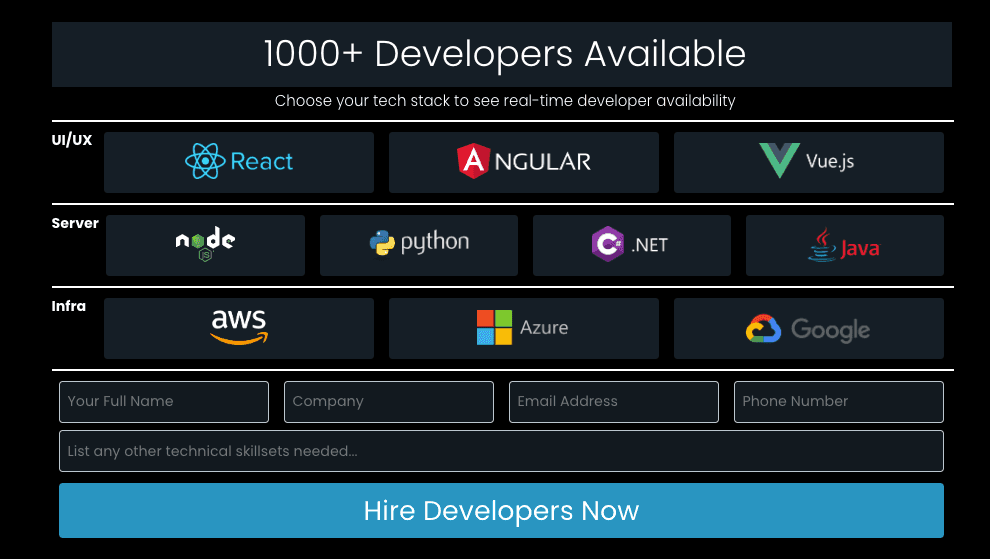
How Fraction’s StackMatch tool screens developers by specific tech stack and business vertical before surfacing them to companies
The exact outcome Lumiant achieved — scaling engineering capacity after a US launch without adding full-time headcount
Why the fractional model is structurally better for startups competing against large employers for the same developer pool
How Praveen Ghanta validated this model across 15 years before building Fraction to scale it across the industry
The US software developer shortage has a paradox at its center: there are plenty of senior engineers. They just aren’t available. They’re employed — well-compensated, at established companies — and startups have no realistic path to recruit them away. Fraction’s platform is built around a different premise: don’t recruit them away. Tap what they have left over.
Why does the software developer shortage hit startups disproportionately hard?
The US software developer shortage is often framed as a supply problem — not enough engineers trained, not enough graduating. But for startups, the real problem is competitive access. Large corporations can offer total compensation packages — salary, equity, benefits, job stability — that early-stage companies simply cannot match. The result is that the candidates who appear on the open job market skew toward less experienced or transitional engineers. The most skilled developers aren’t there.
Definition
Software developer shortage: a persistent gap between demand for software engineering talent and the supply of engineers willing to accept available positions at prevailing market compensation. The shortage is structural — it reflects mismatched incentives and access barriers rather than an absolute lack of qualified people in the workforce.
The largest pool of experienced developers is those who are already working. They are producing code at companies that hired them years ago, have deep stack expertise, and are not actively looking. The fractional model is the only distribution mechanism designed to reach this pool — not by luring engineers away from their jobs, but by creating a legitimate channel for their spare capacity.
How does the fractional developer model actually work?
A fractional developer is a senior engineer who works a defined number of hours per week for a client company without leaving their primary employer. The model has existed informally for decades — Praveen Ghanta, Fraction’s founder, describes using it successfully for 15 years before building Fraction to formalize and scale it.
“This model is perfect for startups who may struggle to compete for developers,” said Ghanta at launch. “I’ve used fractional developers successfully for 15 years — it’s time to scale this solution across the industry.”
The mechanics are straightforward: Fraction recruits and screens senior engineers, manages the engagement structure, and matches them to companies based on technical fit. The company gets senior-level output at a scope they define. The developer earns additional income on a schedule that works around their primary role. No full-time commitment required on either side.
For startups navigating whether to grow headcount or stay lean, the broader question of how software employment is shifting toward specialist roles is directly relevant — fractional hiring is one of the structural responses to that shift.
What is Fraction’s StackMatch tool and how does it screen developers?
Matching a developer to a company on the basis of general programming ability produces mediocre results. A React specialist working in fintech is a fundamentally different hire from a Python engineer with machine learning experience in logistics. StackMatch is Fraction’s answer to this problem.
Dimension
Traditional recruiting
StackMatch
Screening depth
General coding tests, resume review
Stack-specific technical assessment in candidate’s preferred tools
Industry fit
Not systematically assessed
Matched by business vertical alongside technical stack
Time to match
Weeks to months
Days via pre-screened pool
Access to working engineers
Limited to active job seekers
Includes senior engineers currently employed
Fraction subjects every developer to rigorous screening tests within their preferred software stack. Companies can then use StackMatch to search candidates with a deep understanding of a specific tech stack and business vertical — not just general competence. The result is a smaller, higher-signal candidate pool rather than a large pool of questionable matches.
What did Lumiant’s engineering team actually achieve using Fraction?
Lumiant is an advice engagement platform for financial professionals. After successfully launching in the US, the company needed to scale engineering capacity quickly — adding raw headcount through traditional recruiting would have taken months and introduced significant hiring risk.
Fraction provided fractional developers who were matched to Lumiant’s tech stack. The outcome, in the words of Blake Wood, CEO of Lumiant US: “Fraction enabled us to access technically gifted candidates who could quickly get up to speed and get code into production. By augmenting our already incredible engineering and development team with proven talent, we can continue to scale rapidly and be ahead of the curve in delivering an engaging advice experience.”
The specific metric matters: Lumiant was serving more than 6,000 clients around the world at the time of the announcement. The engineering scale-up wasn’t exploratory — it was production-grade, immediate, and measurable.
Need engineers without the hiring overhead?
Describe your project and get a structured scope with story-point pricing and sprint estimates — in minutes, not weeks.
When does fractional make more sense than a full-time engineering hire?
Fractional engineering is not the right answer to every hiring need. A company that needs an engineering manager running daily standups and managing a team of five needs a full-time leader. But for a large class of engineering needs — shipping a specific feature, augmenting a team through a sprint, accessing a technical specialty the in-house team doesn’t have — fractional is structurally superior.
The case for fractional is strongest when the scope is defined and the skill requirement is specific. When those two conditions are true, a fractional developer can get up to speed faster and deliver more focused output than a full-time hire who spends their first two months ramping.
It’s also worth understanding the broader dynamics at play. Research into whether software engineer demand is actually peaking shows that the market is not monolithic — demand for specialist skills continues to grow even as generalist hiring softens. Fractional models are better positioned to serve that specialist demand than traditional full-time recruitment.
For companies that want to understand exactly who Fraction’s fractional engineers are and what they bring to client engagements, the Fraction workforce overview provides a direct look at the talent pool behind the platform.
Frequently asked questions
What is the US software developer shortage and why does it affect startups most?
The US has consistently produced fewer software engineers than the market demands, pushing salaries to levels that leave startups at a structural disadvantage. Large corporations can offer equity packages, brand recognition, and job stability that early-stage companies cannot match. Startups end up competing for a shrinking pool of available candidates rather than the full pool of qualified engineers.
How does the fractional developer model solve the talent shortage?
Rather than trying to recruit engineers away from existing jobs — which is expensive and often impossible — the fractional model taps their spare capacity. Senior developers at established companies work a defined number of hours per week for client companies without leaving their primary role. This unlocks a pool of experienced talent that never appears on the job market.
What is Fraction's StackMatch tool and how does it work?
StackMatch is Fraction’s candidate screening system. Developers are tested within their preferred software stack and business vertical before being made available to companies. When a company searches for a developer, StackMatch surfaces candidates who have demonstrated proficiency in the specific technologies and industry context the company uses — not just general programming ability.
Is a fractional developer the right fit for a company that needs full-time engineering capacity?
Fractional developers are best suited for companies that need senior-level output without the overhead of a full-time hire — for example, a startup scaling a specific feature, augmenting an existing team for a sprint, or accessing a specialized skill set for a defined scope of work. Companies that need someone managing a full engineering organization day-to-day typically require a full-time or fractional CTO rather than fractional individual contributors.
How quickly can a fractional developer get up to speed and ship code?
Speed-to-productivity depends heavily on how well the developer’s stack matches the company’s codebase. The Lumiant case study cited in Fraction’s launch demonstrates that StackMatch-selected developers were able to get up to speed quickly and get code into production — the explicit requirement Lumiant had when scaling technical capacity after their US launch.
What types of companies benefit most from Fraction's developer platform?
Startups and growth-stage companies that struggle to compete for developers in the open market benefit most. Specifically, companies that have a working product and need to scale engineering output without building a large internal team, or those that need a specialized skill set for a defined period, are the strongest fit for the fractional model.
Praveen Ghanta is a five-time founder and serial entrepreneur. He is the founder of DevHawk.ai, an AI-powered engineering management platform, and Fraction.work, which connects fast-growing companies with top fractional tech and growth marketing talent. Previously, he founded HiddenLevers, a risk analytics platform for wealth management that he bootstrapped from inception to acquisition by Orion Advisor Solutions in 2021, serving thousands of advisors and $600B in assets. He earlier founded SmartWorkGroups, acquired by Intralinks in 2000.
Describe your software or AI project. Get a full scope with story-point pricing, sprint estimates, and a downloadable plan in minutes. No calls, no waiting.